
The Four Month Sleep Regression
Exhausted moms everywhere are using the term “sleep regression” whenever baby has a rough night. I totally get it, baby sleep is a complicated thing. Just when you think you have it figured out, baby starts waking every few hours at night, leaving you to wonder what caused the change.
As a certified pediatric sleep consultant, I hear the term “sleep regression” used to explain just about every imaginable scenario. Many people are confident that there’s an eight month regression, a nine month regression, a twelve month regression along with regressions due to teething, separation anxiety and milestones.
But if there’s one thing we can all agree on, it’s the four-month sleep regression. This is the real deal and baby’s sleep will be changed permanently. I get questions about this specific regression all the time, so allow me to explain WHY it happens and HOW you can get through it.

Newborn Sleep Stages
Newborns have 2 sleep stages, REM or active sleep, and Non-REM or quiet, deep sleep. Newborns are noisy and active sleepers because they spend half of their time asleep in active sleep. During REM sleep newborns are active, kicking and flailing and making faces, because they don’t have the same muscular paralysis we do when we’re in REM.
So what does this have to do with the four month sleep regression? Around the third or fourth month (it’s different for every baby), there is a reorganization of sleep. Their sleep cycles change to adopt the 4-stage cycle of sleep that they’ll continue to follow for the rest of their lives.
Stages of the Sleep Cycle
When we sleep, our bodies and brains don’t shut down. Our bodies and brains are actually very active, especially during REM sleep. We actually go through a number of different stages of sleep. These stages make up the “sleep cycle,” which we cycle through several times a night.
Stage 1 is the initial stage of drowsiness where you can just feel yourself drifting off, but you can be easily woken. If you’ve ever had your little one sitting next to you and they’re so tired, but you’re trying to hold them off until nap time you know what I’m talking about. Their eyes start to close, and their head starts to bob forward. At this point you know you need to get them to their crib or bed for naptime ASAP.
Stage 2 is considered the first “true sleep” stage. This stage of sleep is still light, but if you were woken up you would realize you were sleeping. If you are looking to take a “power nap,” this is as deep as you want to go, or else you’re going to wake up groggy.
Stage 3 & 4 is deep and restorative sleep. This stage of sleep is also known as “slow wave” sleep. Deep sleep is a time for cell renewal, immune system repair and when we build up energy for the next day.
Then we enter REM (Rapid Eye Movement) sleep, very active sleep. During this stage the brain organizes and stores all of the information and memories from the day before to be stored in your long-term memory. We do most of our dreaming in this stage and our heart rate and blood pressure increase, even our breathing can become fast and shallow.
After we’ve gone through all of the stages, we cycle back to light sleep. This is when some of us wake up briefly or come close to waking up, and then we go back into deep sleep and REM sleep. These sleep cycles repeat over and over again until the alarm goes off.
Why Sleep Seems to Regress
Have you figured out yet why your little baby goes from sleeping all night peacefully to waking up every 1-2 hours?
As I shared earlier, newborn baby sleep is different from an older baby’s sleep and an adult’s sleep. Newborns only have 2 stages of sleep; deep sleep (Non-REM sleep) and REM sleep, and they spend about half of their sleep in each stage.
So when this “regression” happens, baby goes from 50% REM sleep and 50% deep sleep to spending more time in these new lighter sleep stages. This allows them to make room for those first two stages of sleep. So although REM sleep is light, it’s not as light as these 2 new stages of sleep that they’re trying to adjust to.
With more time spent in lighter sleep, you can imagine what starts to happen. Your baby goes through one sleep cycle and gets to the light stage and starts to wake up. With these lighter stages of sleep repeating over and over, there’s more of a chance that baby’s going to wake up.
Why the Wake Ups Continue
It’s completely natural to have these wake ups throughout the night. In fact, as adults we continue to wake up three, four, five times a night into adulthood and even more as we get older.
The difference is that as adults, we can glance at the clock, know that it’s still nighttime and roll over and go back to sleep. And we do. Usually so quickly that, the next morning, we don’t even remember waking up.
This is very different for a four month old baby, who lacks these critical thinking skills. If your baby fell asleep at her mother’s breast and in your arms, she’s going to wake up a lot more startled. The last thing she remembers is being held comfortably in your arms, maybe with a lullaby singing her off to sleep. Now she’s alone in her bassinet with mom nowhere in sight.
Baby is awake and looking for mom. The only way for baby to communicate that she’s unhappy or upset is to cry. This full waking means that baby is not going to go back to sleep without some reassurance and intervention from mom or dad. Basically, however she fell asleep initially.

What's a Sleep Prop?
A sleep prop is anything external that gets your baby to sleep, that they can’t do on their own. The most common sleep props are feeding to sleep, rocking, bouncing or even laying with Mom or Dad. Pacifiers can also be considered a sleep prop, as most little ones can’t replace them on their own and wake up looking for them.
There is nothing wrong with getting your baby to sleep this way. I’m pretty certain that most parents have rocked or fed their child to sleep at some point.
However, if this is how your baby has been falling asleep it starts to become a problem now at the four month mark. Your baby is now spending more time in light sleep, and therefore has a higher probability of waking up. These sleep props or sleep associations that were key in getting your little one to sleep all night may not work anymore.
Although these techniques may be helpful in getting your little one drowsy or even asleep, when your baby wakes up between sleep cycles, they are going to need YOU to help them get back to sleep. Cue the crying, and the every 1-2 hour wake-ups. This can turn into a nightmarish situation fast.
The positive for anyone going through the dreaded Four Month Sleep Regression is that it’s not, in fact, a regression at all. A regression is defined as “reversion to an earlier mental or behavioral level,” and that’s actually the opposite of what your baby is experiencing. We should be using the term “Four Month Sleep Progression”, even though it doesn’t feel like that.
Creating a Sleep Sanctuary
Some babies may not even experience a full regression, especially if they’re already independent sleepers. When your baby doesn’t have independent sleep skills and is reliant on you getting them to sleep, that’s when it will feel like a true sleep regression.
But let’s focus on what you can do to help your little one adjust to this new sleep. We need to start by creating a sleep sanctuary.
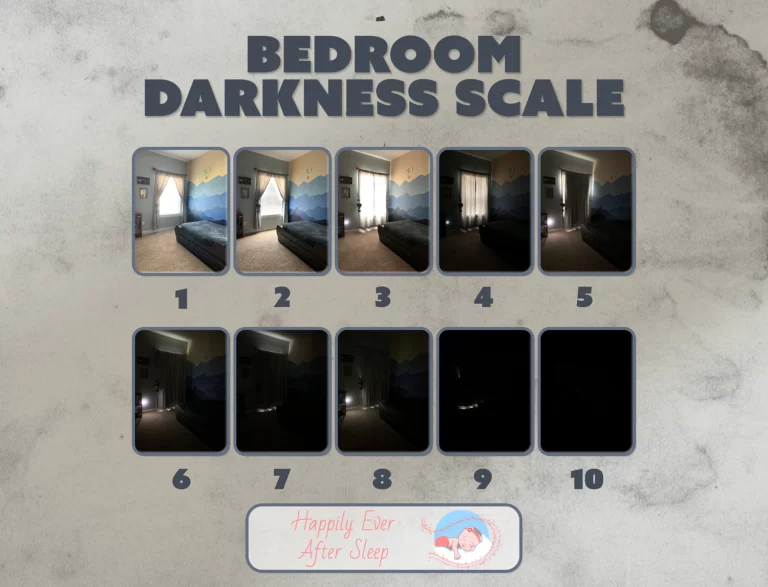
Baby’s sleep best in a dark room, especially once they’re past the newborn stage. You might be saying to yourself, “the room is dark enough” or that a nightlight is harmless. It will help you see during feedings.
I’m here to tell you that it’s probably not dark enough. I’m looking for a 9 or 10 on that chart (pictured above).
Baby’s room should be pitch black dark, like a cave. Any light coming in the side needs to be covered up. Tape garbage bags over the windows if you have to, or cover them with tinfoil.
Newborns and infants are not afraid of the dark, but they are responsive to light. Light tells their brains that it’s daylight and time for activity and alertness. The brain secretes hormones accordingly, so we want to keep that nursery absolutely pitch black during naps and bedtime.
You also want to make sure you block out noises, especially for daytime sleep and to avoid early morning wake ups. With your baby spending more time in lighter sleep, noises will startle them easily and wake them up, so a white noise machine is a great addition to your nursery.
And no, white noise is not a sleep prop. It’s not something that your baby would rely on and can’t sleep without, it’s just something to help facilitate the perfect sleep environment. It also can run without parental presence, so it’s not a prop we need to avoid.
How to Get Through the Regression
If you don’t already have a bedtime routine, now is a great time to start. A short bedtime routine is key to letting your baby know it’s time for sleep. Try to keep the routine to about 4 or 5 steps, and keep them the same every night.
If your baby has a strong feed to sleep association, don’t end the routine with a feed or you risk baby nodding off at the breast or the bottle. After 3 months of age I recommend making the feeding the first step of the routine. Plan the songs, stories, and getting into PJs towards the end. The whole process should be about 30 minutes long. Your baby should go into their crib AWAKE, not drowsy.
By letting your baby fall asleep on their own, from being laid down awake you’re allowing them to enter Stage 1 sleep on their own. If they fall asleep independently at bedtime they will be able to put themselves back to sleep when they wake up in the night. This is the key to getting through the “four month sleep regression”.
If your baby starts getting fussy before bedtime, you’ve probably waited too long. Four month old babies should really only be awake about two hours between snoozes. Bedtime should be between 7 and 8 at night. Start the routine early enough to get your baby in bed by the end of the awake window, before overtiredness sets in.
Other Sleep Transitions and Next Steps
There will be other “sleep regressions” if you want to call it that down the road which can derail your child’s sleep. Traveling, illness, teething and even new milestones can cause your little one to have a few bad nights in a row. But when it comes to the four month “progression,” it’s a one-time thing. Once your baby goes through this transition, they will be following this new sleep cycle for the rest of their life.
Once your baby learns independent sleep skills, they will be able to string those sleep cycles together, independently, prop-free, without any need for nursing, rocking, or pacifiers. That’s giving them the gift of sleep that they’ll have for the rest of their young lives.
Now some babies go through this transition and afterwards are still able to sleep through the night without having to change a thing. However, most parents aren’t that lucky and it does take some time and a plan to get baby’s sleep back on track. If you are worried about sleep training and the effects on your baby, read my blog post about the 4 most common myths.
For those of you struggling with baby’s sleep post regression, I would love to help you through this. With the a customized sleep plan and 1:1 support, your baby will start giving you those long stretches of sleep again.
The most common thing I hear after working with clients is, “I wish I would have never waited!” If you’re considering hiring a consultant, now is absolutely the time. What are you waiting for? Book your call now and we can move forward as soon as you’re ready to get your little one sleeping through the night!